Reich, Johanna.
*1977 in Minden, DE
lives and works Köln, DE
studied at the Kunstakademie Münster,
HfbK Hamburg, Universitat de Barcelona, KHM Köln
Exhibitions [Selection]:
2011 Einzelausstellung „Labor Berlin 4: Reynold Reynolds; Secrets Triology“, Haus der Kulturen der Welt, Berlin, DE
2011 40th International Film Festival Rotterdam, Rotterdam NL
2010 Einzelausstellung „Cuatro Instalaciones de Cine“, Centro de Cultura Antiguo Instituto, Gijon, ES
2010 12th BAFICI Buenos Aires Film Festival, Buenos Aires, ARG
2009 Videonale 12, Kunstmuseum Bonn D
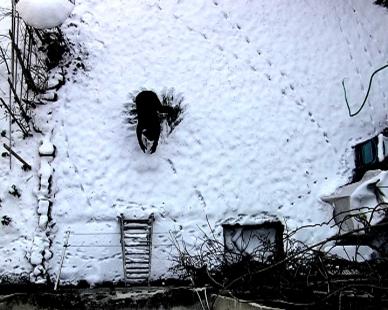
Black hole
Date: 2009
Length: 02:00 min.
Format: 4:3
Specification: Colour, Sound
The stark whiteness of snow contrasts with the utter blackness of the rural landscape. A ladder leaning against a hut, an ivy-covered fence and some sparse winter vegetation seem to be cut-out pieces glued on the sheet of snowy whiteness. An aerial view by the camera further flattens the image, rendering a figure walking out of the hut as a bold black intrusion into the purity of snow.
The person kneels down and starts cleaning up the snow. As the spot of bare ground grows wider, comes the moment of magical transformation: the body that has just disturbed the viewer's attention with its sharp contrast against the snow suddenly melts into the blackness of the earth. The viewer can no longer differentiate the shape of the body. Only the rhythmic sounds of somebody's quiet breathing suggest that the black hole indeed contains a living creature. As the viewer stares into the black hole, the ambiguity of the transformation becomes disturbing. It can be interpreted as a metaphor for people ceasing to be alien elements, achieving instead a benign unity with nature. However, it can also speak of the annihilation of our subjectivity and our failure to establish healthy ties with nature, which has all the power to devour humankind, to transform it into a meaningless black hole.
OC
Interview:
► 1. Your video has been chosen among over 1700 festival entries to participate in Videonale 13. How central the video medium to your overall artistic production? Is it complimentary to other media you use or do you work exclusively with video?
Of my work 91% are videos, 3% photographs, 2% drawings, 1% polaroids… the rest is a secret.
► 2. Is there a particular theme, concept or problem your art addresses the most?
The Presence of Absence. I’m interested in the moment of refusal in this very much media represented time. Throughout little processes I try to find out how one by disappearing or evading from a picture can create a gap that for its part activates existing pictures in the mind of its viewer to refill the gap. I’m fascinated by the camera as an ambivalent opposite; on the one hand the availability of pictures that the camera can (re)produce continuously and everywhere appeals to me, on the other hand especially this medium longs for resisting itself. In my video “Black Hole” for example I’m playing tricks to the camera in an easy and non-digital way by disappearing before its eyes when it’s taking pictures of me.
► 3. What artists do you relate to or find significant for your own art-making?
Especially those from the 21st century
► 4. Do you think the video medium can address social or political issues better than other art media?
No, video is a medium that just does it in a different way.
► 5. Art can be seen as a mirror that registers and reflects life or as a tool that transforms it. Which of the two positions is close to your own art-making philosophy?
The moment art is supposed to be a tool of whatsoever it will lose its freedom. Is art used as a device for change, it gets subordinated to an aim and is as such free from a specific purpose. The great fascination of art is for me its freedom that cannot be captured and is free from any purpose. But it doesn’t mean that art cannot hold up a mirror to society. But instead of regarding art as a mirror, I’d like to see it as a flashlight that is carried around in the pocket and suddenly turned on in the dark…in contrast to the mirror that hasn’t changed for centuries, modern flashlights have LED.
► 6. How do you understand success in an art-making career?
Freedom and independence
► 7. What is the most difficult and the most rewarding thing about making art / being an artist?
1. My own doubt. 2. The Process of Making: the intensity during the development of the new work.
► 8. What are your upcoming projects?
At the moment I’m in the conceptual phase for a new project on the subject of the human body and architecture (in Cologne), that I’d like to carry out with teenagers. The phenomenal ugliness of Cologne has amazed and at the same time fascinated me ever since I’ve been living here. For example I’ve never seen tiled house facades. Otherwise people can google me and can find my current exhibitions.
► 9. What do you do when you don't make art?
(Sleeping. Eating. Having Sex. Swimming.) This question reminds me a lot of autograph books that you had to fill out at school. And everyone describes as a hobby: going to the cinema, listening to music, reading or horseback riding or playing the flute.
