Freund, Peter.
*1960 in USA
lives in in California, USA
Associate Professor of Art at Saint Mary´s College of California
studied at the University at Buffalo.
Exhibitions [Selection]:
2010 Sazmanab Gallery, Tehran, Iran
2008 Universidad de los Andes, Bogotá, Colombia
2007 Museo de Arte, Biblioteca Luis Ángel Arango, Bogotá, Colombia
2007 Do Gallery, St Petersburg, Russia
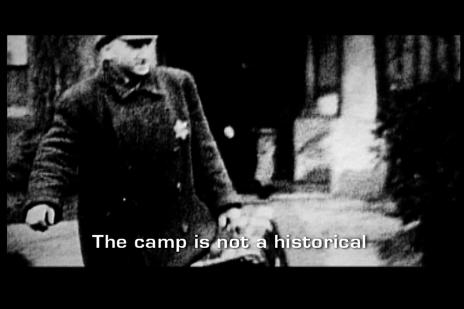
Camp
Date: 2010
Length: 07:00 min
Format: 4:3
Specification: Colour, Sound
Peter Freund's visual and literary collage combines two notions of the word ‘camp’. A camp may signify a place where people are held together in a temporary shelter. Freund narrows down this meaning by using archive footage from Nazi camps and quotes from philosophers on the atrocities of WWII. The second meaning of camp, that of an aesthetic phenomenon marked by consciously artificial behavior, surfaces through a video potpourri of Busby Berkeley's 1943 movie “The Gang's All Here” with quotations from Oscar Wilde and Susan Sontag citations.
Three narrators deliver the literary quotes. The first narrator opens with a question that encapsulates the essence of Freund's intellectual inquiry: We don't want to be indifferent to fascism and concentration camps, but how can we talk about a tragedy that did not happen to us? In this light, the incongruity of Freund's collage ceases to be a mere brazen mismatch between the austerity of black-and-white footage from Auschwitz and the color overload of Berkeley's dance scenes. Perhaps the second meaning of camp can provide a way out of the impossibility of speaking about the concentration camp experience. If we narrate it as a melodrama, through tears and laughter, we will be able to relieve ourselves of this collective trauma of nazism. Won’t we?
OC
Interview:
► 1. Your video has been chosen among over 1700 festival entries to participate in Videonale 13. How central is the video medium to your overall artistic production? Is it complimentary to other media you use or do you work exclusively with video?
I’m interested in media as expressive means that already implicate an audience at the level of the unconscious. In general, I work with video, sound, text, and interactive media; sometimes altogether, sometimes in different combinations, sometimes separately. Video expresses time, incidentally presenting visual and audio components. As art, video can tackle those critical little love objects – the voice and gaze – that look at and speak to the viewer’s pleasure. In this way, the video medium has a special place for me.
► 2. Is there a particular theme, concept or problem your art addresses the most?
In video I’m usually doing a somewhat peculiar form of experimental research. I’m interested in how expressive means capture a subject about which I have some vague but nagging sense of urgency. These are situations where there seems to be no distance between form and meaning, where the explanatory power of an expression seems to completely overtake and dominate what it explains. Through formal tampering I’m interested to see if there’s a possibility of opening up a little space for ambiguity, contradiction, incomprehension, desire. The recurrent goal is to arrive experimentally at a form that hints at, embodies, problematizes the defining blind spot inside the expressive means.
► 3. What artists do you relate to or find significant for your own art-making?
Too many to name. But early on, the biggies were Jean-Luc Godard, Yvonne Rainer, John Heartfield, Thelonious Monk.
► 4. Do you think the video medium can address social or political issues better than other art media?
I’m not convinced the relationship between art and politics is that direct. Rather than asking if the video medium can address political issues, maybe it’s more apt to ask if and how video issues can address social or political media.
► 5. Art can be seen as a mirror that registers and reflects life or as a tool that transforms it. Which of the two positions is close to your own art-making philosophy?
Again, for me, the formulation of the question is better reconsidered. As it reflects, art transforms; and as it transforms, art reflects. The trouble is that life is already fundamentally mediated by art, by a constellation of aesthetics, by phantasmatic imperatives. The question is not if an art-making philosophy is reflective or transformative but how is it already both.
► 6. How do you understand success in an art-making career?
Having the opportunity to present art that allows for public dialogue in new areas, for testing and challenging the limits of the rote, for redirecting pleasure into desire, for meeting other people who want the same.
► 7. What is the most difficult and the most rewarding thing about making art / being an artist?
The most difficult thing is making a career out of art. The most rewarding thing is the process of making and discussing the work.
► 8. What are your upcoming projects?
“Vertigo” – a video piece on turns: inner ear problems, staircases, revolutions, the fibonacci curve, the four discourses of Jacques Lacan, kundalini etc.
“Instrumental Reason” – an interactive digital installation.
► 9. What do you do when you don't make art?
I teach art and critical theory.
